Tampilkan postingan dengan label Pakistani Hindus. Tampilkan semua postingan

Kamis, 19 Mei 2011

Pakistani Hindus visit Sai Baba temple in India

By Mohammad S.Solanki (executive editor)
Thursday, May 19, 2011
( Photo : Sai-Baba )

New Delhi (India) : A group of nearly 135 Pakistani Hindus, including women and children, today visited the famous Sai Baba temple in Shirdi and offered pooja.

The pilgrims, on a one-month long visa, are paying visits to famous Hindu temples in India.
As part of the tour, they visited the Sai Baba Temple here, one of the pilgrims said.

Senin, 02 Mei 2011

Daily Inspiration from Pakistan Hindu Post (PHP)

By PHP Staff
Monday, May 02, 2011
 (Members of the Pakistani Hindu community celebratin Holi in Karachi, Pakistan on Sunday, Feb. 28, 2010)

I am a British born guy of Pakistani and Burmese descent. I’ve been to Pakistan a few times and must say that the indigenous Hindu population should be given greater respect and prominence. The Pakistani treatment of Hindu citizens should be much improved than at current as you are an amazingly dynamic component of the country. Respect to you all.

By Farid M. Khan (United Kingdom)

Sabtu, 02 April 2011

Pakistani Hindus demand their right to register marriages

By PHP Staff
Saturday, April 02, 2011
 (Photo : Hindu women members of Scheduled Cast Rights Movement of Pakistan (SCRM) during a press conference in Islamabad on March 31, 2011, Pakistan)

ISLAMABAD : Calling for an end to institutionalised discrimination going back 62 years, the Scheduled Caste Rights Movement of Pakistan (SCRM) demanded quick passage of a law pertaining to Hindu marriage registration.

In a press conference held here on Thursday, the SCRM pleaded the parliamentarians and concerned citizens to give Hindus the same treatment as other communities vis-a-vis their right to register marriages.

They warned the government that they would launch a forceful campaign if it failed to protect their basic rights, particularly that of marriage registration. They announced the launch of a nation-wide “signature campaign” in this regard.

Hindu women, hailing from different parts of the country, expressed regret over the government’s failure to end injustice against the poor women of the Hindu community. They alleged that they were being discriminated against in the right to possess Computerized National Identity Cards (CNIC), which, in their view, was congruent with a denial of their basic rights of citizenship.

“On not being able to produce marriage registration certificates, we are not entitled to get CNIC, which in turn denies us the right to vote as well. Despite the Supreme Court’s suo motu ruling of November 23 2010 in our favour, no measures have been taken to introduce legal provisions for our rights,” said Sangeeta Devi.

Shami Mai, a poor woman from Rahim Yar Khan, said, “In case of separation or domestic violence, a Hindu woman cannot register a complaint in government departments because she does not have any legal document to establish the perpetrator as her husband.”

Hindu families also face a great deal of problems while travelling. “If we travel or stay in a hotel, policemen and hotel administrations mistreat us. They become suspicious of our relation to each other. If the government passes a law that enables us to register married couples, we would be able to defend our self respect by showing documentary evidence of our statuses. In most cases, we end up spending nights at railway stations or foot-paths,” complained Naina Bai.

In the view of Anita Vadhani, an O-level student, Hindu women faced many more problems than women of other faiths in Pakistan. “If one of our girls is abducted or there is an incident of forced conversion or remarriage, we cannot contest the case in courts because we don’t have marriage certificates,” she told The Express Tribune.

Shanktala Devi, a housewife, said that the absence of marriage registration laws had deprived Hindu women of their right to property and other rights conferred upon a divorced or widowed woman. She urged the quick passage of a bill ensuring them their right to register marriages in local government departments.

The members of the Hindu community threatened to hold a sit-in in front of the parliament building in June if their demands remained unmet. They urged the media and the concerned citizens of Pakistan to show support for their campaign by participating in it.

(Photo : Hindus say denial of legal matrimonial recognition leads to the denial of other basic rights in Pakistan)


Dear Friends,

     Hope you will be fine there. Yesterday SCRM - Actionaid Address a Press Conference on Pakistani Hindu Marriages Registration please see below the  links of news paper and Video.

Please read  Urdu News Paper of Islamabad

 Daily Osaf,Express,Pakistan,sama, Jang,Nawa-e -waqt,Jinnah,

And in English :-

The Nation,The Dawn,the Daily international mail,Express tribune,Pakistan Observer,Daily times,The News, the Frontier Post.

For Mare Details please feel free contact with me

http://www.thefrontierpost.com/News.aspx?ncat=hn&nid=1819

http://www.thefrontierpost.com/News.aspx?ncat=hn&nid=1819

http://www.thenews.com.pk/TodaysPrintDetail.aspx?ID=39232&Cat=6&dt=4%2F1%2F2011

http://www.jang.com.pk/jang/mar2011-daily/31-03-2011/u66936.htm

http://www.youtube.com/watch?v=8iImLkhB_lY

http://www.onepakistan.com/news/local/islamabad/93610-scrm-actionaid-demand-law-for- hindu-marriage-registration.html


For Youtube Video :-


With Regards,
Pakistan Hindu Post (PHP)

Jumat, 25 Maret 2011

On one is safe in Pakistan say Hindu Jatha

By Gopinath Kumar (editor-in-chief)
Friday, March 25, 2011

AMRITSAR (India) : Personal reasons and circumstances make some Hindu and Sikh families migrate from Pakistan to India, and being a minority community, the media quickly highlights such incidents, whereas the situation for everyone in Pakistan was almost the same. Even Muslims were getting abducted and they also live under shadow of terrorism.

These views were expressed by members of the 350 strong Hindu Jatha that arrived in India on Wednesday to participate in a religious function being held at Shadani Darbar, Raipur.

While talking to TOI Dr Haresh Kumar, member national assembly, Pakistan said that, "We discourage Hindus and Sikhs of Pakistan to migrate to India but a few of them have their own personal reasons and concerns."

There were militancy hit areas like Khyber Pakhtunkhwa and Balauchistan where not only minority communities but influential Muslims too fall prey to terrorist activities. "Terrorism is at a peak in these areas and every one gets affected by it irrespective of their religion," he said, while adding that since Hindus and Sikhs were in a minority so they were easily noticed and therefore caught media attention. He said a few Hindu and Sikh family members consider themselves to be in a weak position, so they decide to bid adieu to Pakistan.

Pardeep Kumar, a devotee, said that many a times incidents of terrorism and selective abduction and killing of members of the minority community makes them feel insecure in Pakistan. "But then how can a government that is not safe itself can provide safety and security to its citizens," he questioned. He agreed that many Hindu and Sikh families in Pakistan make up their mind to migrate but eventually drop their plans, when they face visa problems.

"The Pakistan government didn't discriminate against minorities but the incidents of terrorism have spread fear," said Parkash Batra, another devotee. He said the Pakistan government appears to be helpless in protecting the minorities and Muslims as well. "I wonder why incidents of abduction of Muslims don't become media highlights, while anything going wrong with a member of the minority community can become a breaking news," he said.

Many Pakistani Hindus who made an emotional decision to come to India were now willing to go back since they didn't have much financial means to settle themselves and their children, he said quoting one of his relatives, who had migrated to India about two years ago.

Kamis, 24 Maret 2011

300 Pakistani Hindus in India on pilgrimage tour

By PHP Staff
Thursday, March 24, 2011
( Photo : Map of India )

New Delhi : About 300 Pakistani Hindus from the Shadani Darbar crossed the Wagah border checkpost into India on Wednesday to undertake a tour of various Hindu shrines in the country.

Dr. Haresh Kumar, a member of the Pakistan Parliament, said that the delegation was looking forward to the tour. But he also highlighted the problems faced by minority communities in Pakistan, saying that they had been consistently demanding adequate security for themselves and protection of their places of worship.

"Insecurity prevails among minorities, but they showed their intention to come over to India. The Government of Pakistan discourages migration," he claimed.

Admitting that shrine land had been encroached upon, Dr. Kumar said that it was the duty of the Pakistan Evacuee Property Board (PETPB) to protect the shrines belonging to Hindu and Sikhs in Pakistan.

He said that the issue has been raised in the Parliament and the government has ordered an inquiry.

Pardeep Kumar, a devotee, described the situation in Pakistan as worrisome. He claimed that a number of Hindu families wanted to migrate to India, but strict visa rules prevented such a move.

Senin, 21 Maret 2011

Best wishes to you and family for 2011 Holi, By Pakistan Hindu League (PHL)

By Krishna Kumar (PHL)
Monday, March 21, 2011

Best Wishes for 2011 Holi !

May all be auspicious, may all attain peace, let there be fullness and contentment all over, may all be blessed.

Om peace, peace, peace.

May the colors of Holi fill your life with brilliance, joy, friendship, acceptance, discipline and adherence to Truth!

Pakistan Hindu League (PHL)

The festival of Colour

History of Holi

The exact origin of the festival can not be found, though several historians claim that the Holi celebration in the country was brought along with the Aryans. It is also quoted as a reason that Holi is still celebrated with great zeal in the more Aryan dominant Northern and Eastern India. There is also a detailed description of this festival in early religious works such as Jaimini's Purvamimamsa-Sutras and Kathaka-Grhya-Sutras. Several other religious and historical texts also discuss in detail about the festival.

It is said that Holi is celebrated in India, since an immemorial time, even in the period before Christ. However, the meaning of the festival is believed to have changed over the eras and phases. Long ago, Holi was a special rite performed by married women for the happiness, well-being and prosperity of their families and the full moon (Raka) was worshiped for bringing auspiciousness and pleasure. With time the way of celebration has changes. Also, the prominent legends related to the festival have changed with time.

Reference in Ancient Texts and Inscriptions

Holi has a detailed description in the ancient Vedas and Puranas such as ‘Narad Purana’ and ‘Bhavishya Purana’. The festival of Holi also finds detailed descriptions in the Jaimini Mimansa. During an excavation, a stone inscription of 300 BC was found at Ramgarh and this stone inscription has mention of ‘Holikotsav’ i.e. the ‘celebrations of Holi’ written on it. This gives logic to the theories of the historian who believe Holi to be a celebration even before the birth of Christ. Other ancient references like the mention of holikotsav in King Harsha’s Ratnavali written during 7th century and the description of holikotsav in the travelogues of Ulbaruni, support the fact that Holi is not a nascent celebration in the country.

Rituals of Holi

Rituals of the ancient festival of Holi are religiously followed every year with care and enthusiasm.

Preparations

Days before the festival people start gathering wood for the lighting of the bonfire called Holika at the major crossroads of the city. This ensures that at the time of the actual celebration a huge pile of wood is collected.

Holika Dahan Celebrations

Then on the eve of Holi, Holika Dahan takes place. Effigy of Holika, the devil minded sister of demon King Hiranyakashyap is placed in the wood and burnt. For, Holika tried to kill Hiranyakashyap's son Prahlad, an ardent devotee of Lord Naarayana. The ritual symbolises the victory of good over evil and also the triumph of a true devotee.

Children also hurl abuses at Holika and pray pranks, as if they still try to chase away Dhundhi who once troubled little ones in the Kingdom of Prithu. Some people also take embers from the fire to their homes to rekindle their own domestic fires.

Play of Colors
Next day, is of course the main day of Holi celebrations. The day is called Dhuleti

and it is on this day that the actual play of colours take place. There is no tradition of holding puja and is meant for pure enjoyment.

The tradition of playing colours is particularly rampant in north India and even in that region, there can be no comparison to the Holi of Mathura and Vrindavan. In Maharashtra and Gujarat too Holi is celebrated with lot of enthusiasm and fun.

People take extreme delight in spraying colour water on each other with pichkaris or pouring buckets and buckets of it. Singing Bollywood Holi numbers and dancing on the beat of dholak is also a part of the tradition. Amidst all this activity people relish gujiya, mathri, malpuas and other traditional Holi delicacies with great joy.

Drinks, specially thandai laced with bhang is also an intrinsic part of the Holi festivity. Bhang helps to further enhance the spirit of the occasion but if taken in excess it might dampen it also. So caution should be taken while consuming it.

Holi Celebrations in South India

In south India, however, people follow the tradition of worshiping Kaamadeva, the love god of Indian mythology. People have faith in the legend which speak about the great sacrifice of Kaamadeva when he shot his love arrow on Lord Shiva to break his meditation and evoke his interest in worldly affairs.

After, an eventful and funfilled day people become a little sober in the evening and greet friends and relatives by visiting them and exchange sweets. Holi special get togethers are also organised by various cultural organisations to generate harmony and brotherhood in the society.

Reference in Ancient Paintings and Murals

Apart from the reference in the religious and historical texts, Holi also finds a reference in the sculptures on walls of old temples. A 16th century temple at Hampi, the capital of Vijayanagar (now in Karnataka) has a panel sculpted with the joyous scene of Holi celebrations. This painting illustrates a Prince and his Princess standing amidst maids who are waiting with pichkaris to drench the couple in colored water. Another painting on the theme related to Holi, the Vasanta Ragini - spring song or music is found in Ahmednagar in Maharashta. This 16th century painting depicts a royal couple sitting on a huge swing, and several maidens surrounding them playing music and spraying colors with pichkaris.

There are several other illustrations and paintings belonging to medieval India that can be found in the temples and palaces of that era. An interesting painting of Mewar (circa 1755) illustrates the Maharana with his courtiers bestowing gifts and riches on his people while a merry dance is going on. Also, there is water tank filled with colored water in the center of his courtyard. Similarly, a Bundi miniature depicts a king seated on his tusker and some beautiful women showering Gulal (colored powders) on him. These are few of the examples which Holi has been an integral part of the country since ever. It existed here before Christ was born; it continued in the medieval era and is being celebrated in the country till now.

Importance Of Holi Festival


Cultural Significance


The cultural significance of Holi can be gauged from the fact that its origin derives reference from various mythological tales. This has led to a deep faith and respect towards the celebration of the festival, as Indians strongly believe in mythology. The moral behind all these stories is victory of good over evil, which is a lesson for the human race. The tales instill the faith of man into the ultimate power of God and his mercy over his devotees. Holi festival is the medium through which people are inspired to lead a virtuous life. Moreover, the festival is organized at the time when the harvest is at full bloom, giving people an opportunity to rejoice.

Social Significance

The social significance of Holi is seen in the form of the message of unity and brotherhood, it delivers. As per the custom and tradition, people pay visits to their friends and relatives, to give them wishes as well as to strengthen their bonds. The festival brings the nation together, as it is not just celebrated by Hindus but, also by the Sikhs, Christians, Jains as well. The festival is unique, as it does not discriminate against any section of the society and treats everyone equally. The social fabric and secular character of the society is strengthened, since people work on building cordial relations, forgiving their hard feelings for others.

Biological Significance

Apart from the cultural and social significance of the festival, Holi considerably affects the biological system of our body. The time, at which Holi is celebrated, is very crucial with respect to our body. During the festival, the season is going through a change - from winter to summer. It is the period when people feel lethargic and drowsy. Holi provides them the opportunity to wear off their laziness, by enjoying themselves thoroughly.

The dance performances and the music played during the festival rejuvenate the mind and soul. The color, especially Abeer, penetrates the body and strengthens the ions, improving health and beauty. During the tradition of Holika Dahan, people circumambulate around it the fire. This ritual kills the bacteria in the body and makes it clean. During Holi, people clean their houses and remove clutter, thereby ensuring flow of positive energy. Therefore, it can be said that apart from rejuvenating the social ties, Holi provides a wonderful opportunity to let loose all the tension and de-stress the mind.

Holi Celebrations in India

Holi is one of the major festivals of India and celebrated with immense joy and fervor throughout the country. It is celebrated in the month of Phalgun according to the Hindu calendar which commemorates with the month of March in the Gregorian calendar. The date of Holi is decided according to the Hindu calendar according to which the date lying on the Phalgun Purnima is considered the day for Holi. Though the festival is celebrated in most of the parts of the country, the celebrations have a regional influence in their rituals and traditions. The celebration of Holi is known as the ‘celebrations of colors and joys’. Holi starts at midnight with a bonfire of Holika and the celebrations come to climax in the morning when colors and music fill the entire atmosphere with zeal of joy and celebrations.

North India


North India is famous for its rough and tough kind of Holi. Legends say that Lord Krishna spent most of his childhood in Mathura and Vrindavana and he was the one to introduce the modern form of Holi in this part of the country. That is why Holi is celebrated with great enthusiasm at these places for about a week. In North India, the Holi of Mathura and Vrindavana are specially known for its immense enthusiasm and zeal.

In Mathura and Vridavana, the major temples of the region dedicated to Krishna and Radha celebrate Holi on a different day. Very similar to these two places, in most of the North Indian states, Holi means getting drenched with colored water and gulal. It is considered auspicious as well as becomes quite enjoyable. The playful teasing by women and attempts by men to color them with 'gulal' and wet colors from 'pichkari', the attempts to escape and beating the men with sticks to scamper them away makes Holi very fun filling and enjoyable. These celebrations are accompanied with scrumptious food and lip smacking items.

Punjab and Haryana


In Punjab and Haryana, Holi is celebrated in a yet interested way. The brides of the families hang a pot of buttermilk high up in the streets and challenge to their brothers-in-law, who try to get to break the pot by forming a human pyramid. Women try to stop them by beating them with their saris rolled up as ropes. This mock-drama is staged to commemorate the playful pranks of child Krishna, who would steal milk, butter and curd from the maids' houses. In the evening, the brothers-in-law bring sweetmeats for the women of the house for their contribution in keeping the family united. The color play also takes place simultaneously.

Western India

Like Haryana, Maharashtra and Gujarat and other states of West India, also has mock-drama of Krishna trying to break the pots and steal the butter. Besides, this ‘Matka-breaking ceremony’, men in these states also takes out several grand processions singing Holi songs and poems. Soaked with colored water, they walk through the streets and sing to mock alert the people of the house in the locality to take care of their pots of butter and milk as Krishna may come in and steal them. At the time of evening, people visit each others home, exchange sweets and good wishes.

Eastern India

In eastern state of India, West Bengal has an interesting and different kind of Holi. In Bengal, Holi is called Dol Yatra (the Swing Festival) in which idols of Krishna and Radha are placed on swings and devotees take turns to swing them. Women perform devotional songs and dances around the swing as men spray colored water and 'Abeer' (colored powder) on them. However, the tradition is being lost gradually and the modern trend of playing with colored water and powders in the morning and then take out processions on the streets with music and drums has also influenced the Bengali Holi. In Orissa, traditions are similar to that of Bengal except for the fact that the idols of Jagannath is placed on the swing here instead of Krishna and Radha, who is believed to be another form of Krishna. The tradition of sweet exchange, feasting and color play has also become prominent in the state now.

'Vasanta Utsav' in Shantiniketan

Rabindranath Tagore, the Noble laureate from India, revived Holi as the Spring festival by introducing 'Vasanta Utsav' in his Shantiniketan or Bishwabharati University, which is celebrated here in a very special way. Students and youths dress up in bright colorful dresses such as yellow and stage a number of cultural programs involving group choreography, songs and dance followed by playing Holi with 'Abeer' (colored powder). Today, Vasanta Utsav has become an important part of the Bengali culture.

North East

If we talk about the North Esatern Holi, the Holi of Manipur is interesting enough to draw the attention. Holi is a six-day long in Manipur and commences on the full moon day of Phalguna. In the 18th century, it merged with the traditional and centuries-old Yaosang festival of Manipur. In earlier times, there were folk songs and dance performances under the moonlight accompanied by the indigenous drums. Today, modern musical instruments have replaced the drums and fluorescent lamps have replaced the moonlight.

Days before, people collect money from the community for the expenses on the festivities. A thatched hut of hay, twigs and sticks is built, only to be set ablaze. Next morning, groups of boys go to play 'gulal' with the girls and pay them money to get the favor. Devotees play 'gulal', sing devotional songs and dance in front of the Krishna temple dressed in the traditional white and yellow turban. On the last day of the festival, a grand procession is taken out to the main Krishna temple in the capital of Manipur, Imphal where multitude of cultural programs take place.

Holi in Pakistan

Hindus residing in Pakistan also celebrate holi, though, of course, in not as grand a fashion as seen in India.

People celebrate the victory of good over evil forces by lighting bonfires called Holika. The tradition comes from the legend of Prahlad and Hiranyakashyap. In fact, people follow the same traditions and rituals as in India due to their roots in India. People clean their houses and prepare special delicacies like gujiyas, papri and dahi badas. They meet up with friends and play with the colours, dance and generally have good time. Hindus usually gather in temples and celebrate the Holi there. Much gaiety can be seen in temples located in cities which have a comparatively greater Hindu population. Such as in Lahore and Sindh region.

Holi in Bangladesh

Bengal region has a multifaceted culture due to the influence of Buddhist, Hindus and Muslim cultures. Of course, the pomp and show of Holi as witnessed in India is missing, nevertheless, celebrations do take place. Hindu community gather in temples and exchange greetings with each other and play with colours.

Indian culture has influenced Bangladesh a lot as the country is nestled in the crook of the Bay of Bengal and is surrounded by India. It shares a border in the south-east with Myanmar and fronts onto the Bay of Bengal. The country is flat and dominated by the braided strands of the Ganges-Brahmaputra-Jamuna delta.

Holi in Nepal

Holi is celebrated with great pomp and show in Nepal. Celebrations lasts for a week in which the entire country gets drenched in the coloured water.

Celebrations are of marked importance at Terai and also where Indian community mainly Marwaris have settled. Families and friends get together and celebrate the occasion with a lot of merry making.

All over the streets people can be watched having fun, throwing colours and water-balloons, locally called 'lolas' on each other.

Though play of colours takes place on the last day, a ceremonial pole called, 'chir' is installed on the first day. Chir is a bamboo pole fringed with strips of clothes representing good luck charms. As the pole is put up in the street at Basantapur, the festivities and worship commences for the week. At the end of the festivities chir is taken to a bonfire.

There is a popular legend behind the installation of chir. The story is again about the mischievous nature of Krishna who just loved to pray pranks with the milkmaids or gopis. Playful as he was, it is said that once he seduced all the local girls with his dashing good looks. He then danced with them all and when they fully engrossed in him, then he thought they were ripe for a tease. He doused them in coloured water and stole all their clothes while they were bathing in the water of river Yamuna. Naughty Krishna then hung their clothes on a tree to bug them. Chir symbolizes that very tree.

The other legends popular in India as that of Prahlad and his devilish father, Hiranyakashyap. Hiranyakashyap asked his sister, Holika to enter a blazing fire with Prahlad in her lap. However, Prahlad was saved for his extreme devotion by Lord Vishnu while Holika paid a price for her sinister desires. Every year just as in India people in Nepal light a bonfire- called Holika to mark the victory of good over evil.

Also known is the legend of Pootana who tried to kill infant Krishna by feeding her poisonous milk on the direction of devil hearted uncle of Krishna called Kansa.

Holi in Surinam

Holi is celebrated with lot of mirth and excitement in Surinam which has a large number of Indians. Hindus constitute about 35-40% of the population, an important part of this is people who immigrated from Uttar Pradesh and Bihar.

Just as in India, people here take great delight in spraying colour on each other and singing Holi songs. Holika is also burnt on the eve of Holi which is symbolic of victory of good over evil.

There is a similarity in the way Holi is celebrated in Surinam and that in Guyana and Trinidad and Tobago. Here too, people plant a castor oil plant weeks before the festival and this plant is burnt later as Holika. Between these days people engage themselves in nightly chowtaal and taan singing at each other's homes or at the temples.

Delicacies like bara, gulgula, phulourie, bigany, mango or tamarind chutney, potato ball, prasad, channa, ghoja, mahambhoog, kheer or sweet rice, among others beverage are prepared and served at the temples where large Holi gatherings takes place.

Holi in United Kingdom

Hindus settled in UK do not miss out the excitement of Holi celebrations and enjoy to the hilt. Zeal for the festival is particularly marked in this country as Indians constitute the second largest ethnic minority. Celebrating festivals help them to feel close to their families and cultural roots.

The celebration of Holi is noticeable at places that witness a large congregation of Indians. The British city of Leicester is particularly known for its love for celebrating Indian festivals. Excitement reaches its peak when the occasion is that of celebrating a joyous festival like Holi.

Children love to use their spray cans and colour each other. Holi parades are also carried and in the evening people visit their friends and relatives to exchange greetings and sweets. They hug each other and also apply the tilak as the meet Holi in a traditional manner.

Holi in USA

With a large population of Indians settled in the United States of America, Holi is celebrated with gaiety and lot of fanfare in this country.

Different societies formed by the Indians and religious organisations help people to celebrate this joyous festival and feel close to their cultural roots. Music programmes and Holi Meets are also organised by them to mark the occasion. These meets help the new generation to identify with their cultural root. Children learn to understand the significance of celebrating festivals and know legends asociated with them.

Great enthusiasm for the festival can be specially witnessed in cities where large number of Indians have settled. Holi celebrations are particularly marked in the city of New York.

Here Holi parades are taken out. People can be seen having so much fun in these parades as they play with the colour in the midst. There is so much revelry here that it becomes difficult to imagine that New York is not a part of India.

Bollywood actors also take time out to celebrate Holi with the people of USA doubling the excitement for the festival. Dance performance, fashion shows and music concerts further add to the festive spirit.

Senin, 14 Maret 2011

An Introduction To Hinduism (By Padmaja Patel, M.D.)

By Dr.Radhe Shyam Kumar (Executive Editor)
Monday, March 14, 2011


Part 1 ( Introduction To Hinduism)

Hinduism is one of the oldest religions in the world and is followed by 1 billion Hindus worldwide. Hinduism is not a monolithic tradition, there isn’t one Hindu opinion on things and there is no single spiritual authority to define matters for the faith.   There are several different denominations, the four largest being: Vaishnavism, Saivism, Shaktism and Smartism. Further, there are numberless schools of thought or sampradayas, expressed in tens of thousands of guru lineages or paramparas. Each is typically independent and self-contained in its authority.

The Basic Principles of Hinduism:

>> Karma: Karma literally means deed or act and more broadly names the universal principle of cause and effect, action and reaction, which governs all life. Karma is the natural law of the mind, just as gravity is a law of matter. Karma is not fate, for man acts with free will, creating his own destiny. Karma refers to the totality of our actions and the concomitant reactions in this and previous lives, all of which determines our future.

>> Reincarnation: A natural process of birth, death and rebirth. At death, we drop off the physical body and continue evolving in the inner worlds in our subtle bodies, until we again enter into birth. Through the ages, reincarnation has been the great consoling element within Hinduism, eliminating the fear of death. The actions set in motion in previous lives form the tendencies and conditions for the next.

>> All Pervasive Divinity: As a family of faiths, Hinduism upholds a wide array of perspectives on the Divine, yet all worship the One, All Pervasive Supreme Being, hailed in the Upanishads.

>> Dharma: Dharma is God’s Divine Law, prevailing on every level of existence, from the sustaining cosmic order to religious and moral laws which bind us in harmony with that order in relation to the soul, dharma is a mode of conduct most conducive to spiritual advancement, the right and the righteous path.

>> Hindu Scriptures: The holiest and most revered Hindu scriptures are the Vedas and Agamas, revealed by God to illumined sages centuries and millennia ago. The most widely known part of the Vedas are the Upanishads which form the more general philosophical foundations of the faith. The era of secondary scripture of which are the Itihasas, specifically the Ramayana and Mahabharata and the Puranas. The ever-popular Bhagavad Gita is a small portion of the Mahabharata.


Part 2 ( The Nature of God in Hinduism)

A common misconception is in the idea that Hindus worship a trinity of Gods: Brahma, the Creator; Vishnu, the Preserver; and Siva, the Destroyer. To the Hindu, these three are aspects of the one Supreme Being. Indeed, with its vast array of Divinities, Hinduism may, to an outsider, appear polytheistic.   Depending on which of the four major denominations (Saivism, Shaktism, Smartism or Vaishnavism) a Hindu follows, he may refer to God as Siva, or perhaps Devi, maybe Vishnu or one of His earthly incarnations, Rama or Krishna.

Some venerate God as male, others as female, while still others hold that God is not limited by gender. This freedom makes for the richest understanding of God.

God is unimaginably transcendent yet ubiquitously immanent in all things. He is the creator and He is the creation. He is farther away than the farthest star and closer than our breath.

 If His presence were to be removed from any one thing, that thing would cease to exist.
A crucial point is that having one Supreme God does not repudiate the existence of lesser Divinities. Each denomination worships the Supreme God and its own pantheon of divine beings.   The elephant-faced Lord Ganesha is among the most popular and is perhaps the only Deity worshiped by Hindus of all denominations.   There are Gods and Goddesses of strength, yoga, learning, art, music, wealth and culture.

There are also minor divinities, village Gods and Goddesses, who are invoked for protection, health and such earthy matters as a fruitful harvest.


Part 3 ( The nature of the soul)

A common misconception is in the idea that Hindus worship a trinity of Gods: Brahma, the Creator; Vishnu, the Preserver; and Siva, the Destroyer. To the Hindu, these three are aspects of the one Supreme Being. Indeed, with its vast array of Divinities, Hinduism may, to an outsider, appear polytheistic.   Depending on which of the four major denominations (Saivism, Shaktism, Smartism or Vaishnavism) a Hindu follows, he may refer to God as Siva, or perhaps Devi, maybe Vishnu or one of His earthly incarnations, Rama or Krishna.

Some venerate God as male, others as female, while still others hold that God is not limited by gender. This freedom makes for the richest understanding of God.

God is unimaginably transcendent yet ubiquitously immanent in all things. He is the creator and He is the creation. He is farther away than the farthest star and closer than our breath.

 If His presence were to be removed from any one thing, that thing would cease to exist.
A crucial point is that having one Supreme God does not repudiate the existence of lesser Divinities. Each denomination worships the Supreme God and its own pantheon of divine beings.   The elephant-faced Lord Ganesha is among the most popular and is perhaps the only Deity worshiped by Hindus of all denominations.   There are Gods and Goddesses of strength, yoga, learning, art, music, wealth and culture.

There are also minor divinities, village Gods and Goddesses, who are invoked for protection, health and such earthy matters as a fruitful harvest.

 Source: Hinduism Today, www.hinduismtoday.com

NOTE : Patel is a member of the Council of Trustees at HAWT and has been a practicing internal medicine physician in Midland for 11 years.   Nowhere on Earth have religions thrived in such close proximity as in India. For thousands of years, India has been home to followers of virtually every major world religion, the exemplar of tolerance toward all paths.

Rabu, 09 Maret 2011

Pictures of 2011 Maha Shivratri Celebrated in Mansehra Shiv Temple, Pakistan

By Gopinath Kumar (editor-in-chief)
Wednesday, March 09, 2011

(Photo : 2011 Maha-Shivratri at Mansera (NWFP) by Rajesh Pandit and Pakistan Hindu Post (PHP), Pakistan)

Namasty !

            Maha Shivratri was celebrated in Shiv mandir at Mansehra (NWFP) Pakistan. People came all over from NWFP & Punjab aswell. This temple is one of the oldest temples in world, according local people they says that it is 2,000 years old. Muslims people say that they have seen a snake couple in this temple.

           This Temple of Maha Dev is located in Mansehra Division near to Abbotabad NWFP (Pakistan). Many Hindus peoples come every Maha Shivratri. On 2nd March 2011 all from Punjab and NWFP people came to celebrate Maha Shivratri. Pandit Rajesh Kalyan, Pandit Chaman Lal & Sewa Dhari Mr.Darshan lal do pooja with the local peoples. You can see Shiv Lingam this is the tallest Shiv Lingam in Pakistan.

If anyone in Pakistan or out of country visit this temple so please contact to Rajesh Pandit Kalyan & Mr.Darshan Lal.

Contact No. +92 03325135398
                  +92 03459584649

 (Photo : Location of Mansehra District (highlighted in yellow) within the Khyber Pakhtunkhwa Province, Pakistan)

Mansehra District (Urdu: مانسہرہ) is in the Khyber Pakhtunkhwa province of Pakistan, an area still unofficially known as the Northwest Frontier. Mansehra district and town are named after Man Singh, a leading general of Mughal Emperor Akbar. The Kaghan Valley area (a popular tourist destination) and the Karakoram Highway pass through the district.

Maha Shivaratri means "The Great Night of Siva". The night of Shiva falls on the eve of the New Moon. The night is symbolic of a condition prior to creation and refers to the chaos that existed before light. But this chaotic darkness is not a negative condition. It is pure consciousness without the pollution of knowledge. In the Buddha's terminology it is the Emptiness of Nirvana.

Every year during The Great Night of Shiva, Lord Shiva incarnates in the form of the Shiva Lingam. Maha Shivaratri is the prime time for every soul to get into the primordial consciousness of non-existence or Nirvana. One is required to keep vigil during the night in order to receive Shiva's grace and assistance.

As you keep vigil this night, you become aware of your life and karma. It is a great opportunity to connect with the divine formless form of Lord Shiva, the Lingam, who symbolizes 'all-auspiciousness', and to invite these energies in your life. In essence, Maha Shivaratri signifies the transition from the darkness of gloom and ignorance to the dawn of divine joy and knowledge.

Please see an attach file of 2011 Maha Shivratri Celebrated in Mansehra Shiv Temple, Pakistan

With Regards,
Rajesh Pandit (PHP Islamabad)
Sanjesh Sunny (PHP Karachi)

(Photo : 2011 Maha Shivratri Celebrated and Local Hindus standing in front of Shiv Temple in Mansehra, Pakistan)
(Photo : 2011 Maha Shivratri Celebrated in Mansehra Shiv Temple, Pakistan)
 (Photo : PHP Banner for 2011 Maha Shivratri Celebrated in Mansehra Shiv Temple, Pakistan)
 (Photo : SRSSM Banner for 2011 Maha Shivratri Celebrated in Mansehra Shiv Temple, Pakistan)
 (Photo : PHP/SRDSSM Calender at 2011 Maha Shivratri Celebrated in Mansehra Shiv Temple, Pakistan)
 (Photo : Shiv Ling is in Mansehra Division Khabher Phaktun Khawha Pakistan. It is 10ft high above from earth. It is the highest Shivlingam in Pakistan)
 (Photo : Rajesh Pandit with local Hindu womens for 2011 Maha Shivratri Celebrated in Mansehra Shiv Temple, Pakistan)
 (Photo : Kids and women performing religious rites for 2011 Maha Shivratri Celebrated in Mansehra Shiv Temple, Pakistan)

Introduction : Rajesh Pandit is scholar, a teacher, particularly one skilled in Sanskrit and Hindu law, religion, music or philosophy and he is also active member of PHP Islambad based reporter.

Write us email if any more information is required at namastepakistan@gmail.com

The PHP Team

Senin, 07 Maret 2011

Pictures of 2011 Maha Shivratri Celebration at Katas Raj, Pakistan

By Jaykrishna  (PHP Punjab)
Monday, March 07, 2011

(Photo : PHP & HRF at Katas Raj (Maha Shivratri 2011) Banners, Pakistan)

Namasty !

       2011 Yatra of Shri Katast Raj was organized by All Pakistan Hindu Rights Movement (APHRM) with coordination of Hare Rama Foundation-Pakistan (HRF-P), Pakistan Hindu Post (PHP) and HAF. There we distributed the Katas Raj Cards, 2011 Calenders by HAF/PHP and Lord Shiv pictures, Vegetarian Bhandara for all devotees, Tea stall and 3 Grooms Wedding Ceremony (Traditional Hindu way) in Katas Raj also took place. We had invited around 700 peoples for the event.


       Among prominent attendant guests were Ramesh Jaipal (Chairman of SCRM and Director of PHP), Pt.Guru Sukh Dev ji (President of HRF) and also Miss.Aneeta Wadhani, Mr.Ratan Lal (Sialkot Hindu Leader), Mr.Amernath Randhawa (Lahore Hindu Leader) and last but not least of dear friend Mr.Haroon Sarab Diyal leader of Peshawar based Hindu community in NWFP, Pakistan.

Please see an attach file of 2011 Katas Yatra celebration.

With Regards,
Ramesh Jaipal
(PHP, Pakistan)

 (1 Photo : 2011 Shri Katast Raj Yatra on Maha-Shivratri event, Pakistan)
  (2 Photo : 2011 Shri Katast Raj Yatra on Maha-Shivratri event, Pakistan)
   (3 Photo : 2011 Shri Katast Raj Yatra on Maha-Shivratri event, Pakistan)
 (4 Photo : 2011 Shri Katast Raj Yatra on Maha-Shivratri event, Pakistan)
 (5 Photo : 2011 Shri Katast Raj Yatra on Maha-Shivratri event, Pakistan)

Introduction : Katasraj Mandir (Punjabi: کٹاس راج مندر (Shahmukhi), कटासराज मन्दिर (Devanagari)) is a Hindu mandir situated in Katas village in the Chakwal district of Punjab in Pakistan. Dedicated to Lord Shiva, the temple has existed since the days of Mahābhārata and the Pandava brothers spent a substantial part of their exile at the site. The Pakistan Government is considering nominating the temple complex for World Heritage Site status. It also proposes to spend about Rs 20 million in three phases for the restoration of the complex.

For more information please contact : namastepakistan@gmail.com

The PHP Team

Rabu, 02 Maret 2011

Pakistan's Hindu temples turned into picnic spots, hotels (By Rediff News)

By Mohammad S.Solanki (Executive Editor)
Wednesday, March 02, 2011

(Photo : Hindu temple at Chakwal, Pakistan) 


Hindus in Pakistan are watching helplessly as ancient temples turn into ruins due to the apathy of authorities, reports Tahir Ali from Islamabad.


Despite being the second largest ethnic majority in the country, Hindus in Pakistan have been unable to acquire possession of their religious places, agricultural land and other commercial areas. Due to lack of government action, most sacred sites for Hindus are in a dilapidated condition; the rest have been converted into schools, hotels or business centres.

According to the National Commission for Inter-Religious Dialogue and Ecumenism, Pakistan is home to 3.9 million (39 lakh) Hindus. Most members of the minority community belong to impoverished agricultural families. 


A report of the Evacuee Trust Property Board reveals that 135,000 acres of land belonging to Hindu farmers is under the control of ETBP, of which 125,000 acres is fertile and suitable for cultivation.

'Hindus are left behind in every walk of life'

(Photo : Haroon Sayab Diyal, chairman of the Pakistan Hindu Rights Movement)

A number of sacred sites, commercial spaces and other properties are also in the possession of ETBP. Ironically, to control Hindu assets and properties, ETPB employs extensive machinery comprising mostly of Muslim workers. Local Hindus have demanded that the ETPB should give them some jobs, as it is reluctant to hand over the possession of their assets.


"The Hindus are left behind in every walk of life. They don't have possession of their sacred places and other properties. If Hindus were given the possession of their assets, their misery could be alleviated," Haroon Sayab Diyal, chairman of the Pakistan Hindu Rights Movement, told rediff.com.

'Hindus won't have to rely on special quotas for jobs'

(Photo : Hindu devotees at a temple in Pakistan)

Haroon Diyal says, "Handing over these properties to the original heirs would also enable the Hindu minority population to stand on its feet. Our youngsters will be able to avail the various educational opportunities. After receiving proper qualifications, they can function as citizens of Pakistan -- no one would then have to rely on special quotas for jobs."

Pakistani Hindus complain that their sacred sites are misused by illegal possessors. In Dera Ismail Khan's Khyber Pakhtunkhwa province, a group has illegally acquired the 700-year-old Kali Bari Mandir and is now using it as a hotel.

'The temple is used in an unholy way

(Photo : A tourist at an old temple near Islamabad, Pakistan)
According to local Hindus, the occupants of the temple pay only Pakistani Rs 1,600 to the government and earn thousands of rupees per day from the hotel. 

Vijay Kumar, a Hindu activist, says, "Due to the hotel's activities, the temple is used in an unholy way. Though a number of sacred idols are missing from the temple, this historically important site could attract Hindu pilgrims from around the globe."


Though the Hindu community has taken up this issue a number of times with the government, no action has been taken so far. "In April 2009, after our request to the then governor of KPK Owais Ghani, an inquiry was ordered in the case of the disputed Kali Bari Mandir, but no action was taken about it," says Diyal.          


The issue of Kali Bari is not an isolated example. In Islamabad, Hindus have no access to a temple situated at Saidpur model village.


'Authorities should hand over the temple'

(Photo : Devotees light oil lamps in a temple in Karachi, Pakistan)


The Raam Kunday Mandir in Islamabad, once considered a sacred site by Hindus, is being converted into a picnic spot.


"Authorities in the capital should hand this temple over to the Hindus of the country to represent Hinduism in the capital," says Haroon Diyal.


In Abbottabad city of KPK province, a Hindu temple called Araya Mandir is located next to the local Gurdwara. 


This temple, which is already in a decrepit condition, is being used as a school for children. Hindus have demanded that they should be granted the possession of the temple and the school should be relocated, as it is endangering the existence of the religious structure.


Temples are in a shambles today

(Photo : A temple in Chakwal, Pakistan)


A Jama Masjid is located in the same area and according to Diyal, a renovated temple at the site would present a concrete example of interfaith harmony, with a gurudwara, a mosque and a temple co-existing peacefully. 


Members of the Hindu community have also demanded the possession of another temple in Hasan Abdal, but the authorities are yet to pay heed to them.


Eminabad in Gujranwala region has several temples dating back to the 15th century, which are in shambles today. Most of them are being used as stables to provide shelter to donkeys, horses and other animals.

Temple being used by salt miners

(Photo : A temple in Chakwal, Pakistan)


A famous Hanuman temple in Chakwal is being used by the workers of salt mines as their office. In spite of local Hindus demanding the possession of this temple, the authorities are allowing the mine workers to use it.


Another Kali temple in Peshawar has been taken over by some local traders, who are converting the temple into a building. Again, the authorities have been apprised of the situation but are yet to take any steps to prevent the violation of this sacred site.


In Punjab's Bakkar city, Sheeran Wali Mandir has been used by Islamic clerics as a madrasa.


Some temples are on the verge of collapse

(Photo : A file photo of Pakistani police guarding a Hindu temple in Multan)


According to Diyal, Hindus have no objection to the teaching of Islamic education, but the building is on the verge of collapse as no repair work has been undertaken there.


Similarly, Jogi Tala Jhelum, a sacred site for Hindus as well as Sikhs, is also in a pitiable condition. Hindus have also demanded the possession of Laho Maharaj Mandir, located in Badshahi Masjid, which is currently under the control of ETPB.

Government not ready to take care of temples

(Photo : Children play outside an old Hindu temple at Saidpur village on the outskirts of Islamabad, Pakistan)


Nearly 360 sacred Hindu sites are located in Pakistan, including Hanglaj Maata Mandir in Balochistan, Sadho Beela Mandir in Sindh, Hanuman Mandir in Kotri, Kali Ma and Shiva Mandir in Punjab's Imanabad, Ganga Khogi in Saidan Shah Punjab, Kali Bari Mandir and Kala Sathi Kewal Raam in Dera Ismail Khan, Raam Takht in Swat and a Shiva Mandir in Mansehra. 


But neither is the government ready to ensure the upkeep of these sites, nor is it willing to hand them back to the Hindu community.


The PHP Team

Happy Maha Shivratri by SRSSM, HRF and PHP, Pakistan

By Mohammad S.Solanki (Executive Editor)
Wednesday, March 02, 2011

---------- Forwarded message ----------
From: Sanjay Saim (PHP Karachi)
Date: Tue, Mar 1, 2011 at 6:53 AM
Subject: Maha Shivratri Ki Dher Sari Shubhkamna
To: Pakistan Hindu Post (PHP)

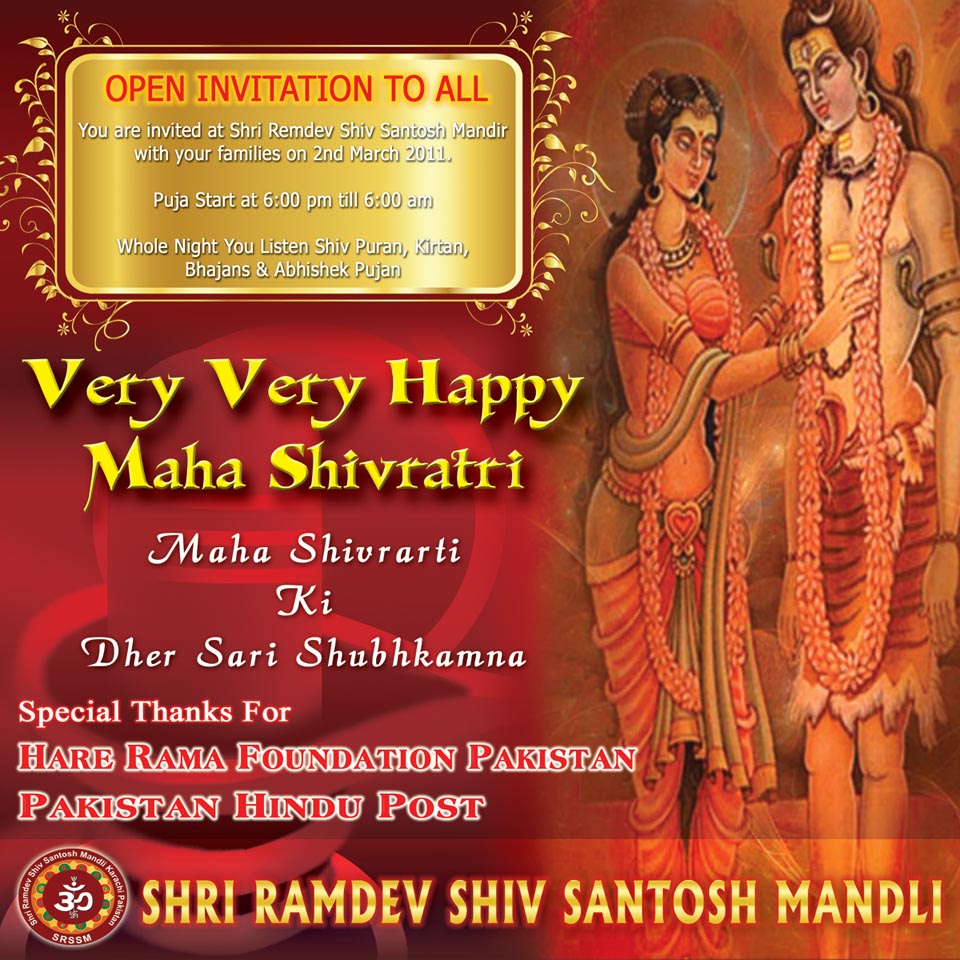
(1 Photo : 2011 Maha Shivratri Banner by SRSSM, HRF and PHP, Pakistan)

Namastey! All

INVITATION TO ALL,

You are invited at Shri Ramdev Shiv Santosh Mandir with your families.

Date: 02nd March 2011
Puja Start at 06:00 pm till 06:00 am

Whole night you listen Shiv Puran, kirtan, bhajans & Abishek Pujan

Regards,
Sanjesh Sunny
(Karachi,Pakistan)


 (2 Photo : 2011 Maha Shivratri Banner by SRSSM, HRF and PHP, Pakistan)

Introduction : Shri Ramdev Shiv Santosh Mandli, hereafter referred to as S.R.S.S.M, is a society of young people with diverse cultural backgrounds sharing a common belief in Hindu culture. This society is for every Hindu you can join us easily, there is no caste system in this society & there is no age limit either, everyone has the equal rights. We hold a wide range of events throughout the year from our popular Diwali to the fun of Holi.

This Society presents preservation and promotion of Hindu philosophy, values, traditions and practices help present and future generations of Hindus experience and sustain a rich cultural and religious heritage. Through Hindu concepts, the Society aspires to create healthy minds; purposeful, progressive individuals; and happy, stable family units and promote friendship among members. This, in turn, contributes to the wholesomeness of the community and of the adopted nation, while maintaining spiritual and cultural identity.

Below is link of SRSSM -
http://srssm.blogspot.com/

The PHP Team

Selasa, 01 Maret 2011

Disquiet among Pakistani Hindus over kidnapped leader

By PHP Staff
Tuesday, March 01, 2011

(Photo : Map_of_Pakistan)

Islamabad : There is disquiet in the Hindu community over the as-yet unsolved abduction of their religious leader, a senior Pakistan Muslim League-Nawaz (PML-N) leader in Quetta has been told.

Sardar Sanaullah Zehri, provincial convener of the PML-N, said all efforts will be made to free Lakki Chand Garji from the captivity of his abductors.

 (Photo : Lakki Chand Garji (B. 1929) is the maharaja (head) of the Kali Mata Mandir in Kalat town, and is considered to be one of Pakistan’s most revered Hindu spiritual leaders is abducted now in Balochistan of Pakistan)

Lakki Chand Garji, 82, who is the 'maharaja' of the Kali Mata Mandir in Kalat town in Balochistan province and considered to be one of Pakistan's most revered Hindu spiritual leaders, was kidnapped by a gang of armed men Dec 21 last year. He is yet to be traced and rescued.

A delegation headed by Santosh Kumar Bugti met Zehri and apprised him of disquiet prevailing in the community over their religious leader not yet being traced or freed, the Dawn reported Friday.

Zehri called Garji's abduction a conspiracy to defame the Baloch people and assured the delegation that tribal influence would be used in this regard.

Abduction for ransom and killing of people belonging to Pakistan's minority communities, including Hindus, has caused insecurity among them, Balochistan Minister for Minorities Affairs Basant Lal Gulshan said earlier this month.

Traders from the Hindu community have been targets of kidnapping gangs.

Rajesh Kumar, a trader, was going to work when armed men in a car intercepted him and tried to kidnap him in Feb 6. When he resisted, he was shot dead. As many as three Hindu traders have been killed so far during attempted kidnappings in and around Quetta during the past three years.

Gulshan said that people belonging to the minority communities were being compelled to migrate to safer places.

 (Photo : Ram Singh Sodho (born 16 January 1945) is a former Pakistani Hindu politician. A member of the opposition Pakistan Muslim League (Q), he held a seat reserved for non-Muslims in the Provincial Assembly of Sindh, but in 2011 resigned and moved to India)

Ram Singh Sodho, who was elected to the Sindh assembly in 2008 on a Pakistan Muslim League-Functional (PML-F) reserved seat for minorities, fled to India and sent in his resignation to assembly Speaker Nisar Ahmad Khoro.

The PHP Team

Hindu Youth Council of Pakistan (HYCP) needs your input, please !

By Gopinath Kumar (editor-in-chief)
Tuesday, March 01, 2011


(Photo : Hindu Youth's group after celebrating religious festival in Pakistan)


Dear All.
Following is the Mission Statement, and the Objectives of Hindu Youth Council of Pakistan (HYCP), the core of the organization. Please take your time, and give us your feedback. Don't hesitate to let us know where to improve, and what to drop. Thanks.


Hindu Youth Council of Pakistan (HYCP)
A Forward Looking Organization to
Develop Youth for a Better Tomorrow

Email: namastepakistan@gmail.com his e-mail address is being protected from spambots. You need JavaScript enabled to view it

Background
Hindu Youth Council of Pakistan (HYCP) can be a non-governmental organization (NGOs), registered under Societies Act 1860 in Hyderabad, Sindh, Pakistan. The  (HYCP) is a non-profitable, non-sectarian, and politically impartial organization. Yet to be Founded in 2011, the  (HYCP) is striving to uplift the masses in various sectors. Our society is facing problems in multiple areas that are hampering the real progress of the people in our country. We identified problems in number of segments of the life including, but not limited to education, health, human rights, disaster management, infrastructure, child abuse, domestic violence, lack of marketable skills, lack of employment opportunities, copy culture in educational institutions, air pollution, environmental issues, and many more.

We called a meeting of a few dedicated community activists, and development professionals to discuss the deteriorating social structure of the province. We decided in this meeting to create a platform that could provide assistance and training to young volunteers in leadership skills to build their communities through co-operative efforts. Thus we established Hindu Youth Council that will initially focus on the following areas: Advocacy of the social issues, disaster management training, emergency response training, developmental awareness in society, youth empowerment and empowerment of women, awareness against religious militancy and religious intolerance, capacity building, health, education, and career development.
Hindu Youth Council of Pakistan (HYCP) is a forum where youth can speak, interact, deliver their ideas and take part in conferences and seminars

Mission Statement
The Hindu Youth Council of Pakistan (HYCP) strives to educate youth to further the humanitarian mission by promoting importance of education, empowering women of poverty stricken areas, discouraging religious extremism, promoting religious and sectarian tolerance, creating political awareness, and creating social responsibility by empowering youth and young adults to become community and organizational leaders. Drawing upon their creativity, dedication, and energy, the Hindu Youth Council seeks to promote youth as an organizational resource and help them reach their full potential in serving their communities through the co-operative efforts.

Objectives
  • Awareness Programs: The society is infested with many ills, such as, but not limited to political exploitation, break down of the social structure, terrorism, religious militancy, religious intolerance, human rights violations, drug abuse, child abuse, crimes against women, honor killings of women, copy culture in educational institutions, and lack of merit in education. One of the main reasons of the spread of terrorism is the lack of proper education and awareness among youth. We strive to build a tolerant society by discouraging religious militancy, and promoting love and peace through Hinduism. Creating awareness is the main thrust of HYCP mission. The HYCP will launch programs to create political awareness and a sense of social responsibility among our youth.HYCP will establish neighborhood tuition centers based on self-help, conduct seminars and town-hall meetings, hold musical concerts, make presentations in schools, distribute literature, initiate interactive dialogue, setup discussion groups, to create awareness among youth, and build a better society for all.
  • Disaster Management Centers: HYCP is a responsible organization whose Members take part in responding to humanity when disaster strikes. We train our Members in the daunting tasks of rescuing, providing relief, and taking part in rehabilitation of the victims of natural and manmade disasters.
  • Equal Rights for Women: Equal rights for women are basic principles of human rights. HYCP will promote the human rights of the woman, and strive to bring equality to the women’s rights in society. We will launch mass campaigns to fight crimes against women, namely Karo-Kari. Launch awareness campaigns to educate women about their human rights, and to fight against the domestic abuse of the women. Establish call centers and counseling groups in co-operation with the administration to provide protection to women under threat.
  • Youth Development Centers: One of the main objectives of HYCP is to setup free Youth Development Centers to provide job search skills, interview skills, office automation, basic computer skills, vocational training, and counseling in under developed areas of Sindh to enable youth to find employment leading to a better life.
  • Health: Promoting health and hygiene awareness through HYCP field workers in rural and under developed areas, and promote sustainable development to provide primary and immediate health care to the poor and needy. HYCP strives to establish free medical camps in low income areas, and mobile medical clinics for the poor and needy.
  • Income Opportunities to Rural Areas: In order to provide sustainable progress in rural and under developed areas, people must be provided real income opportunities. HYCP will setup small handicraft units and offshore IT fulfillment centers to provide sustainable income opportunities to the rural area population. We will train women to produce home décor, and other handicraft items that have market in big cities and overseas, as well as setup IT centers to train youth and young adults on IT related offshore projects.
  • Education to Underprivileged: The main culprit in producing terrorism and religious militancy is the lack of traditional education in the rural and underprivileged areas. Education in these areas is also essential in bringing the true development to the poor and under privileged people of urban and rural communities. Education will improve the lifestyle and income opportunities of the masses, and create awareness against the militancy and intolerance.
  • Capacity Building: HYCP will strive to build capacity of its Members by training, counseling, and information sharing. We will work to provide welfare to the women and disabled in the community to initiate sustainable progress.
  • Human Resource Training: Proper human resource training is essential to strengthen public and private sectors in leading the society to a sustainable development. HYCP will provide human resource training in multiple disciplines to provide efficiency, productivity, better customer service and encourage transparency in public matters. Our professional trainers will conduct training seminars, provide in-house and on location classroom training to improve job skills and the level of motivation.


Gopinath Kumar
Editor,
Pakistan Hindu Post (PHP)
Temporary Chairman,
Hindu Youth Council of Pakistan (HYCP)